MY STILL LIFE II
One Clean Cut
by John Small

My Still Life · Book Two
John Small
Page 1 of 48 · 2% read
One Clean Cut
by John Small
Year One
There was a man on the front in a black hat.
That is where you would start, if you were from here and somebody asked. Not with the name. With the hat, and the fold-up stool, and the board propped against one knee in weather that had cleared the promenade of everybody else who had a choice about it.
Summer, anybody would. February is the bit people tell you about.
Nine years on the same view, near enough, and he would say so himself if you stopped, cheerful as anything, like a man telling you how long he had left to serve. Thirty-one on the Headland altogether. Long enough to be owed something and not long enough to get it.
Everybody had a version of him. He'd been a musician once, that was one. He'd had a wife and lost her, that was another, and it went round for years without anybody minding where it started. A lot of people up here will tell you he came for a woman and stopped for the light, and say it like they were stood there when he decided.
He never said. That was the thing about him. He would talk to you the length of the front and you would get up Northgate before you worked out he had not told you one thing about himself, and you would still have had a lovely chat.
And he waved. Everybody got a wave. It cost him nothing and they'll all still tell you about it.
"Did you hear? Ted's passed away."
The post office queue took the news the way it took everything — slowly, over the top of its pension book, with one eye on the scales. It was a long queue. It has been ever since they shut the one in the town centre and the choice came down to the Brus shops or come over to Northgate, and there's a fair few that would sooner do the extra mile than stand on the Brus corner — which the Headland has views about, and expresses in the shoulders. There is nothing to do in a long queue but talk.
"Which Ted?"
"The painter. Him off the front. Black hat. You know."
"Oh, him. Well." A pause, the exact length of respect. "He wasn't from round here originally, was he."
"Where was he from, like?"
"Darlo, I think."
A little silence went round the queue, of the sort kept for the recently dead and the badly born.
"Well. He wasn't a real monkey hanger, then, was he."
And nobody argued with that. There is a beach down there where the town is supposed to have took a monkey off a wreck, decided it was a Frenchman, and hanged it, and there's loads that'll tell you the whole thing came out of a song, and it makes not one bit of difference. It's true enough up here to name a football mascot after. It's true enough to fight over on Church Street any year Darlo come down for a match. This is a town that built a wall to keep the Scots out and lost the town anyway, and has never once let that put it off the principle of the thing.
He'd lived on the Headland thirty-one years. The Headland has a long memory and a longer doorstep, and you can die on it, but you can't be from it. There's families up here that still call the nineteen-fifties "them new houses."
Third in the queue, a man in a work coat studied the parcel shelf like it owed him money and said nothing, which was noticed. Everything on the Headland is noticed. The noticing is done from behind nets, over fences, through the gap the chapel door leaves when it's propped for airing, and it is done kindly and it is done cruelly and mostly it can't tell the difference. John had been noticed all his life. He'd been noticed especially, one bad year, back when he was young and somebody died and the queue had needed somewhere to put it. He kept his eyes on the parcel shelf. Let them lie, he thought. The dead have done their bit. They shouldn't have to do the entertaining as well.
"Heart, they're saying."
"On the street, mind. Middle of the morning."
"Shocking." Said comfortably. There is no comfort on earth like other people's news.
"They say a lass got to him first. Down on her knees in the road. And a fella did the — you know, the pressing. Kept him going till the ambulance come."
"Did it work?"
"Well, he's dead, so."
The queue moved up one.
She came in then, with the door making its usual production of it, and it went round the shop the way weather goes round the Headland — her, off the flats above the old shop, her that was there, the one that knelt down. The queue didn't look at her. The queue looked at the greetings cards, hard, the whole rack of them, Deepest Sympathy going three deep by the window, and looked at her that way. She'd been in for stamps. She stood behind John, close enough that the queue could feel it. It arranged itself accordingly.
They knew each other now, if a week counts for knowing. Seven days since a Monday morning on the front, since flowers went one way across the pavement and a man went the other, and two strangers ended up kneeling on the same flagstones with their hands full of the same going-out life. You don't stay strangers after that. Whether you turn into anything else is a separate question, and the town had answered it before either of them had — it had them married off by teatime that same day, it does the matchmaking early up here, it saves everyone the bother of courting. And for once, give it credit, it had called something right. Or half right. The town is only ever half right, which is worse than wrong, because the half that's right keeps you listening.
"They're doing him Thursday," the counter said, franking as it spoke. "St Hilda's. Eleven."
"Big do?"
"Solicitor's arranging it. No family come forward."
And there it went, the whole of a man, thirty-one years of him, folded into no family come forward and filed under Thursday. The scales settled. Somebody bought a card off the rack, the third one back, and asked for a book of seconds.
Outside, the sea was doing its usual work below the church, taking the Headland away a grain at a time, patient as a solicitor itself. It had heard the news before anybody. It gets everything first, the sea, and passes nothing on.
John held the door for her without quite being asked.
"Thursday," she said. Not a question.
"Aye," he said. "Thursday."
The Headland does a wedding before anybody's asked anybody. It had the two of them up the aisle by Whitsun, and it hadn't even got their names right — him off the boats and her from the flats — but it had the date pencilled in all the same.
What actually happened was slower, and better, and none of the town's business, so the town supplied its own version. It usually does. The version has chips in it, and a bench, and him walking her up the bank home. The version happens to be true, is the annoying thing. The bench was the one above the fish sands. The chips were shared out of one paper, which up here is as good as a ring.
Thursday had done what Thursdays do. Eleven o'clock, St Hilda's, fourteen mourners counted in and the count passed round the shop by one. The solicitor stood at the back with his coat on. And afterwards, on the path between the graves, he'd asked were they the two — the ones that were there — and said there was the matter of the effects. No family come forward. There was a painting, he said, among other things. It seemed right it should go to somebody who'd — he hadn't finished the sentence. Nobody could have.
So the painting came to the flat above the old shop, wrapped in brown paper and string like something off the ration, and she cut the string with the kitchen scissors and went quiet.
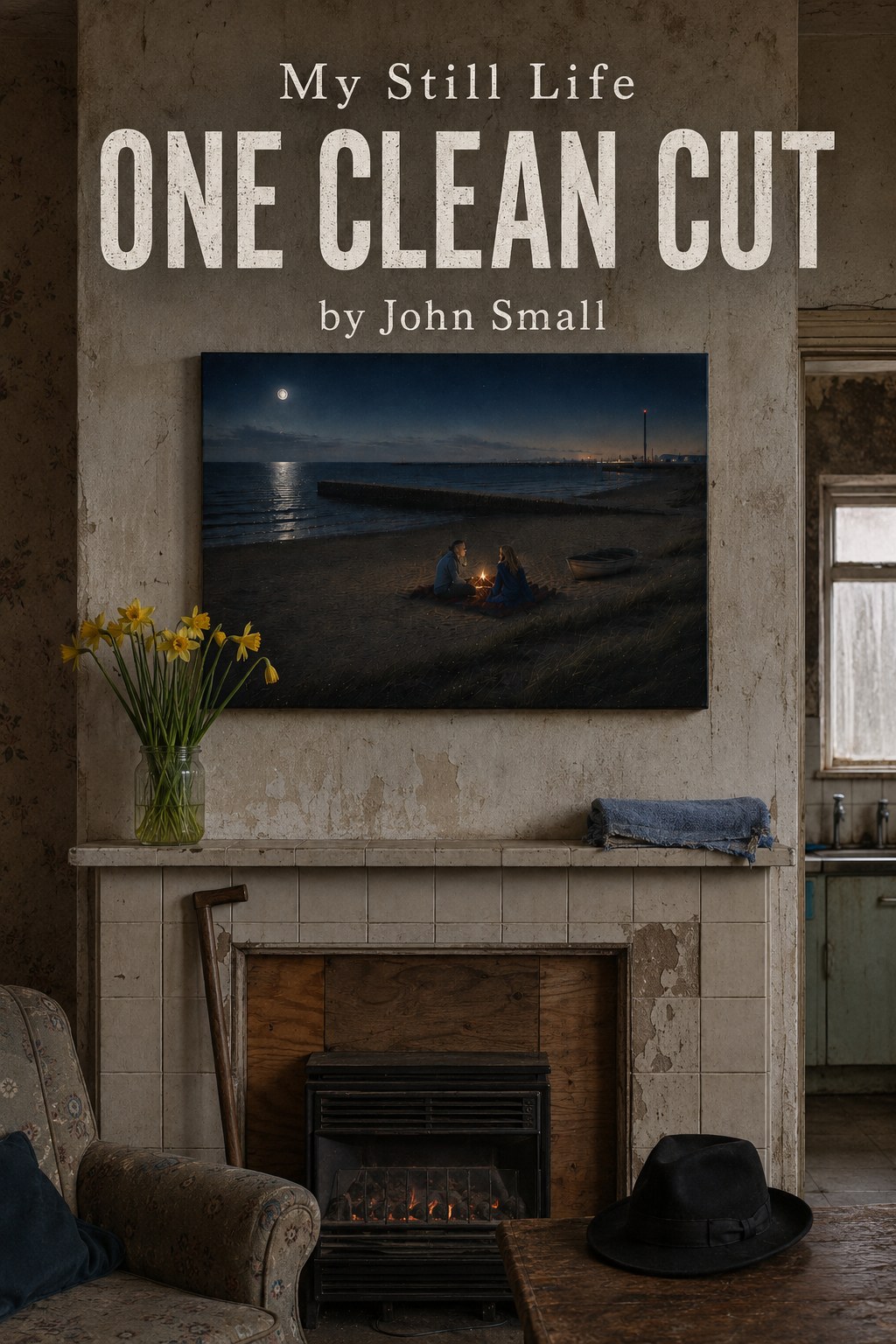
A beach. Two figures by a fire, small, and completely warm. Cream sand going beige, and the whole thing lit like somebody had loved it.
"That's us," she said. "John. That's us."
He looked at it a long time. Two people he didn't recognise, on a night he'd been there for. That's what a painter does to you, he supposed. Tidies you up. Puts you where he can see you.
"Could be anybody," he said, but he said it soft, and he helped her hang it, and it went over the fireplace because she wouldn't have it anywhere else. The flat had one good wall and now the fire had it.
Spring went green the way it does up here, grudging about it, then all at once. He had her down the allotment by May, and she was no use whatsoever, which turned out to be the point.
"What's that one?"
"Weed."
"It's got a flower on."
"It's a weed with a flower on."
She pulled it up anyway and put it in the jam jar on the shed windowsill, where it stayed all summer, and every time he saw it he thought about saying something and didn't. Dave's pigeons went up off the loft like a shaken sheet and she said, out loud, before she could stop herself, "Where do they go?" — and Dave, six gates along, called back "Nowhere. They just want telling they can," which was the most anybody had got out of Dave in a decade, and John looked at the ground and grinned at it.
They ate their sandwiches on the bench with their backs to the works.
"You never ask us owt," she said.
"You never stop telling us."
"That's because you never ask." She looked at him sideways. "Go on. Ask us summat."
He thought about it seriously, which she liked, because most men fired straight away and the shot was always the same one. "What's the flower for."
"The jar?" She laughed. "God. Nowt. It was nice. Ask us a proper one."
"That was a proper one."
And she went quiet, and then she told him things in the order you tell them, with the flask going cold between her hands: the father first, gone when she was seven; the one after that, the one who left; the sea, last, and least, like it was nothing, like it hadn't nearly had her. He didn't say sorry, which she'd been braced for. He said, "Right," at intervals, in a voice with a floor under it, and dug the row out while she talked. By the end there was thirty foot of turned earth. She felt lighter than she had in a decade. Neither of them remarked on it.
He gave her his in return. Most of it. There was a year he went round, the way you'd go round a hole in the road. She noticed — she noticed like the town notices, kindly, and didn't dig. Plenty of time, she thought. She was in that stage of it where the not-knowing is still romantic.
And Ted came with them everywhere that summer. That was the thing nobody warned him about. Every sunny day was the sort of day he'd have painted. Every daffodil in every yard — and the Headland does daffodils the way it does gossip, in bulk — got a little silence held over it. She'd started saying he and meaning only one man, and it was never John.
"He saw us before we did," she said one night, glass in hand, looking at the wall. "He painted us together before we'd even met. Doesn't that — doesn't that do something to you?"
"It does something," John said.
She fell asleep on his arm, easy as anything, the television talking to itself. And John sat in the low light with a dead man's picture over the grate, and the fire in the painting was brighter than anything in the room, and he stayed like that a while, not moving, so as not to wake her.
August came in on carnival weekend, and the Headland put its bunting up, same bunting, same nails, strung over the front the way it has been every August that anybody can account for. The boat festival is Easter and belongs to the wharf, with the stalls and the masts and the men admiring hulls with their hands behind their backs. This is the Headland's own do, and the Headland does not share.
The band came up from the town and the town came up after it, in its summer clothes, to stand about on somebody else's front and say the weather had held.
She wore the dress. The flowery one, the summer one, bought that morning off the rail outside the shop that's a card shop now — and the town clocked it off her back before she'd got the length of the church. Dressed up, her. Down the front with him off the boats. Lovely, that. Make a nice couple. Well, they are a couple. The Headland likes a happy ending, so long as it gets to write it.
Under the dress was the other thing. The red. Four months in the drawer, still in its tissue, kept — she couldn't have told you what for, except that she could have, and wouldn't. She'd bought it the day after the sea gave her back, on a Sunday, for an audience of none. And tonight, getting ready, with the brass practising somewhere and the evening coming up gold off the water, she'd taken it out of the tissue at last, and put it on, and stood in front of the mirror in it, and the mirror had agreed with her. Tonight had a reason in it. She'd know it when it happened. That had always been the arrangement.
They did the carnival like the town wanted them to. Chips out of one paper on the sea wall. The band getting through its list. His arm went round her on the bench above the fish sands and the sun went down the way it does in August, taking its time, showing off, and she thought — this. This is what it was for. The sea, the fire, the flagstones, the whole terrible way in. It was all so that a man like this would be sitting here with his arm round her while the light went.
They walked up the bank in the dark and she took him home, and at the door of the bedroom she stopped him with a hand flat on his chest, and said, "Wait there," in a voice she'd been saving as long as the tissue paper.
She came out with her hair down, in the red.
And he was lovely about it. That was the word her head kept reaching for, after, and hating. Lovely. He said she was beautiful and he meant it — she could tell meant-it from ten years off, she'd been lied to by professionals. He took his time. He was gentle. It was warm, and good, and kind. At no point did the roof come off the building. She'd built a night in her head since Easter. Wildness. A man undone by her, helpless with it, the red doing to him what red does. And instead she got a man of forty who'd seen the sea take people and give them back, who held her like something rescued, and made love to her like a long answer to a short question, and fell asleep first, one arm across her, heavy as a towline.
She lay there in the dark with his breathing on her shoulder and the red on the floor where it had ended up, one strap of it caught in the light off the streetlamp, tissue paper still on the dresser like a little burst of applause that had gone off at the wrong moment.
Nothing was wrong. She went through it twice. He was good, and kind, and here, and hers, and nothing was wrong, and she stared at the ceiling with her eyes wide open in the best year of her life.
She'd kept it since the sea gave her back, for a night that would mean something.
It had meant something to him. That was the trouble.
Year Two
The solicitor got round to the rest of it at Easter, which was a year to the week, and nobody planned that, because on the Headland nothing is planned, it is only got round to. A year dead, and Ted came up the stairs to the flat in two cardboard boxes with a man's coat rained on over the top of them.
No family come forward. The words had gone round the shop so often they'd worn smooth, like the step into the chapel. Somewhere in an office in town, a file had sat open on a windowsill for twelve months waiting for a cousin, a nephew, anybody — and nobody had come, and the law had done its sums, and the sums said: the ones that were there. The town approved. The town had decided long ago that the kneeling meant something, and here was the proof, delivered, in boxes.
She took the afternoon off for it. He came up after work and found her on the floor of the front room with the lids off and the light going, surrounded by a dead man she'd met once, for a minute, on the worst morning of his life.
Brushes, gone stiff. A tobacco tin with nothing in it but the smell. A scarf. Photographs in a bread bag — gigs, by the look, somewhere with low lights, young faces round a table, and she went through them one at a time like a woman dealing cards, saying look at him, look how young, and John looked, and it was faces in a pub, years back, strangers all the way down.
And then the diaries. Five of them, different sizes, spines gone soft, held together in a bundle with a bootlace. The years wrote small on the front covers in a hand that leaned into the wind.
"John." She'd gone quiet the way she did in front of the painting. "It's him. It's his voice."
He said maybe those were private, and heard the sentence arrive dead on the carpet. You couldn't tell her a shrine was private. She was already in the first one, cross-legged, lamp on, reading with her lips just moving — and then reading out loud, because it couldn't be helped, because the man wrote like he painted, tidied the world up till you could see it: the sea off the Headland doing its slow burglary, the works standing there holding nothing up, some lass on the front in a red coat "like the only lit window in the street." She read that one three times. John went and made the tea.
The shop had the boxes before the boxes had got up the stairs. Two of them, and a coat. Everything he had, and it fitted in the back of a solicitor's estate. Well. He never had owt, mind. He had that big picture. Aye, and they've got that an all.
The year went that way. Tuesday nights, telly off, lamp on, listen to this one. Ted on painting. Ted on loneliness — he had it folded up neat, loneliness, like the man had done an apprenticeship in it. Ted on the young ones who used to come round his shed, years back, half the Headland's wildest, sat cross-legged in pallet-wood smoke calling him a genius. The town could have told her some things about those years. The town had said some things, at the time, over the scales and under the dryers. Genius wasn't always the word it used.
But the town wasn't in the room. She was, with her feet tucked under her and her face lit up off a dead man's sentences, saying doesn't he just get it, John, doesn't he see right through everything —
"He's got a way with him," John said. "Had."
It came out of the past tense like a corrective, and she looked up — nothing sharp, just a look, just a beat — and went back to the page. And John sat with his tea going cold and the painting over the grate, two small figures warm by a fire he'd built with his own hands, and listened to his front room fill up with another man's voice, read lovingly, in hers.
He left them alone the best part of a year. Easter to Christmas and past it, five soft spines on the shelf by her chair and him walking round them like a hole in the road. It was a Sunday in February when he found it, and he found it because he'd gone looking at last, which he never admitted to anybody, including the man he was looking at in the shaving mirror.
She was at her work — the café did Sunday dinners through winter, the Headland eats Sunday dinner like it's still eighteen ninety — and the flat had that afternoon stillness in it, radio off, painting keeping its two people warm above a cold grate. And the diaries sat where they lived now, on the shelf by her chair, bootlace gone, spines out. Domesticated. Shelved like family.
He told himself he wanted to know what she saw in them. That part was even true.
He took the earliest one. She'd been working forwards; he went backwards, into the years the town still muttered about, the shed years, and the man's voice was younger in them and louder, the handwriting bigger, more sail in it. Gigs. Paint he couldn't afford. Some woman in Middlesbrough who came and went across ten pages and left the man writing about the sea for a month. And the young ones, always the young ones, coming round the allotment like gulls after a boat: they think I know something. I've started to let them.
John read that twice. It was the first sentence of Ted's he'd ever liked.
The light went the way February light goes, all at once, about four. He should have stopped and put the lamp on. He didn't stop.
Good crowd round the shed after the Borough Hall gig. That lad who's always furious about something brought his records. Somebody's lass sat in the corner at the finish, mouse-quiet, wouldn't take an ale. Took a smoke off us in the end though. — and then her name.
Just her name. First name, in a dead man's leaning hand, halfway down a right-hand page, in a sentence about nothing. The most ordinary sentence in the world.
Nobody had said that name out loud on the Headland in thirteen years. The town had worn it out in one terrible summer and then dropped it, the way the town does, and it had gone from the scales and the dryers and the bus stop, and after a while it only existed in one place, and the place was John, and he'd kept it shut like a tin.
And here it was. Shelved. In the front room. By the chair.
He sat there in the dark with the book open on his knee and did the arithmetic he'd spent half his life not doing. The dates fit. They fit like a key fits. Took a smoke off us in the end though — her first, then. Before him, before any of it, before the year the town needed somewhere to put a death and chose John to put it on. He'd carried the blame so long it had changed shape, gone from a stone to a limp — you'd only notice it if you knew him, and nobody knew him, that was the design of him. And the whole time, the start of the thread was here, in a shed, in a kindness. An old fool passing something round a fire because the young ones thought he knew something, and he'd started to let them.
He waited for the fury. He sat in the dark and gave it every chance.
What came instead — and it shamed him, the size of it — was relief. A door in him swinging on its own weight. Because if it started there, in the smoke, in the shed, before him — then it hadn't started with John. He hadn't been the whole road. He'd been a place on it.
Her key in the door, stairs, the light snapped on — "You're sat in the dark, you —" and laughter, cold coming off her coat.
"Aye," he said. "Lost track."
The diary went back on the shelf, spine out, in its place in the family. He knew the name now. He made the tea, and said nowt.
The café did forty-one dinners on the first Sunday in February, which was a record for the room, and she was the reason, and nobody in that flat ever heard about it.
She was good at it, and not good in the way people meant when they said she was lovely with the customers — good the way a mechanic is good, in the wrists, in the timing. She could hold six tables in her head with the gravy going and know to the half-minute when the Yorkshires wanted turning. She ran the pass on her own from twelve till three with the radio on and the window streaming, and she never once wrote an order down. Leanne had tried to make her write them down. Leanne had given up.
There's a man that came in every Sunday on his own and had the beef. By the third week she'd learned to leave the paper on the table and give him no conversation whatsoever. She gave him that for two years. He tipped like a drunk at Christmas. They never learned each other's names, which made it one of the more successful relationships in the building.
She liked the walk home best. Bins out, apron in the bag, past the corner where the Brus Arms had been until it wasn't, three o'clock light going lilac over the works, the smell of forty-one dinners coming off her coat. She'd run the takings in her head the whole way for the pleasure of it — the room was thirty pounds up on last February, and she liked knowing it before Leanne did. She wanted the till job when Leanne's knees finally went, and she'd been saying so out loud to nobody, on this exact stretch of pavement, for about a month.
She never mentioned it at home. Not because he'd have minded. Because it was hers, and she had so little that was, and a thing stops being yours the minute somebody else has an opinion on it.
Spring came back round, the way it insists on doing, and the Headland noticed a change in him off the boats, and got it wrong, which was traditional.
He's filled out a bit. He's canny lately, John — said morning to us by the lifeboat station, whole sentence, near enough. She's the making of him, that lass. The town likes a before-and-after. It had him down as a man mended by love, and it was half right, which is the town's speciality, and the half it had wrong was the whole story. He was lighter. Anybody could see it. He dug the allotment over in March like a man getting rid of something. Dave's pigeons went up off the loft, and John watched them go round and said, to nobody, to the birds, "They'll come back," and laughed — and Dave looked at him like the shed had spoken.
What had actually happened was February, and a name, and a door swinging shut on thirteen years, so quietly that the man it happened to could hardly point to it. It doesn't announce. It just stops hurting on the stairs one day and doesn't mention it. And there's a cruelty built into it that nobody warns you about: it can't be shared. Grief you can sit in a room with. Healing happens to one person at a time, alone, and the other person only sees the lightness arrive from nowhere, unexplained, unearned — like money you won't say where you got.
There was one bad night that year, and they got past it, and the getting past it was the mistake.
A Friday in June, nothing in it. Somebody in the shop had said something about her — nothing, less than nothing, one of them remarks the Headland files under only joking — and she had carried it up the bank and up the stairs and taken a drink on top of it, and by ten o'clock it was not about the shop any more. He never did work out what it was about. He said the wrong flat thing in the wrong flat voice, which was all his voice had, and she went off like a dropped tray. Twenty minutes of it. Things said that could not be unsaid and were, in the morning, unsaid anyway. And at the end of it her arm went out along the windowsill and took the lot — jar, water, the weed with the flower on that had lived there since May — and it went into the tiles and stopped being anything.
She cried for an hour. She was sick with it. She said she would rather have cut her own hand off, and meant it, which was the trouble with her: she always meant it, at both ends.
He swept the glass up himself and put it in the bin and washed his hands, and in the morning he said it once, at the sink, not looking at her.
"I had a house full of shouting when I was a bairn. I've had a lifetime of it since. I'll not have it again." And then, because she had gone very still: "I'm not threatening you. I'm telling you what I am. If it comes to that, I'll not stop and argue. I'll just be away."
"It won't," she said.
And it didn't. Not again. That is the thing about a fault in the ground — it does not have to do anything at all, most of the time, and it is still exactly where it was.
She saw it. Of course she saw it. She noticed like the town notices.
"You're different lately," she said, over tea, careful as a woman testing ice. "Good different." And then, because he was never far off it: "It's this year, isn't it. Everything that's — I honestly think he brought us summat, John. I do. Even now. He's still — I feel him still doing things for us."
And John, who knew exactly what the dead man had done, and to whom, and when, looked at her over the rim of his mug and had his one chance, arguably, right there, in the steam and the lamplight, while it was still small. He could have gone to the shelf and opened February and put his finger on a line and given her the name out of the tin, and it would have been a wound, and it would have been theirs, shared, the way the fire had been theirs and the flagstones had been theirs.
"Aye," he said. "Maybe he did."
Because you don't hand a wound to a woman who worships the knife. That was the reasoning, if it was reasoning. She'd built the man an altar out of a minute on a pavement. What was February going to do, set against that? He'd be asking her to bury the saint who'd introduced them, on the word of a dead girl the town had already buried twice. No. Let her have the shrine. He could carry the rest. He was good at carrying. It was the family trade.
So the year went on golden, and the gap went on opening, and the terrible thing about the gap was that it looked, from every angle the town possessed, exactly like happiness. He got lighter, and she took the credit on Ted's behalf. She read the diaries — through the winter she'd finished the lot and started again, she had favourites now, she had passages — and he watched her underline a dead man in pencil and thought about a right-hand page in the earliest book that she'd read straight past, a name that meant nothing to her, resting an inch under her thumb.
They were happy that year. The town got that bit right, which should have worried somebody.
On the shelf by her chair, five soft spines stood in a row, and one of them had a tin shut inside it, and only the dead man and John knew which.
Year Three
The third year began with a project, because her love had always needed jobs to do.
She was going to put the photographs in an album. They'd sat in the bread bag long enough, she said; it wasn't right, a man's whole life loose in plastic; and she'd got to the stage of the diaries where she knew the cast — the Middlesbrough woman, the lad with the records, the lass in the red coat — and she wanted faces for them. She bought the album in town, proper one, ivory pages, the sort you'd keep a family in.
So that was the winter: her at the table with the diaries open for reference, dealing photographs into years like patience, writing little pencil dates on the backs. And John by the fire, half a paper up, listening to the commentary — that's the shed, look, that's Dave's fence behind — God, the state of the trousers on them — and letting it wash, because the tin was shut, because February was two years buried, because he'd checked the bread bag himself one quiet Tuesday, early on, and found nothing but strangers.
He should have checked the envelope. There's always an envelope.
It was stuck to the bottom of the second box, damp-sealed by thirteen years of loft, and she came at it with the kitchen kettle like a safecracker, patient, delighted, steaming a dead man's post open on a Sunday afternoon. Inside: a flyer for a gig at the Borough Hall, a fiver on the door. And one photograph, stiff, glossy once, the flash gone yellow round the edges.
A table in low light. Seven of them, eight — young, smoky, immortal, the way everybody is in the one photograph that survives. Ted in the middle of it, of course, black hat shoved back, mid-laugh, a man holding court in his own weather. And she was smiling at it, already reaching for the pencil, and then she stopped smiling.
John felt the room change before she said a word.
"That's —" Her finger went to a face at the table's edge. A young man side-on to the camera, dark, furious about something even sitting down, a record sleeve flat under one hand like he was keeping it from flying off. "John. That's him. That's —" and she said a name John had never heard her say, a name from the one story she'd only ever told him once, in the shed doorway, in the order you tell them: the father first, then the one who left.
The one who left was twenty-three years old and sitting at Ted's table with his hand on a record.
"He can't be," she said, reasonably, to the photograph. "He wasn't from — he never said he knew —" and then she stopped, because the diaries were open on the table, and she was the one who knew them by heart, and somewhere in the earliest one, in a sentence she'd read aloud herself one Tuesday, laughing, was a lad who was always furious about something, who brought his records round the shed.
She went for the diary.
And John didn't move. Because he had seen the photograph too, the whole of it, and his eye had gone where hers hadn't — past the furious lad, into the corner of the frame, where a girl sat mouse-quiet at the edge of the light with an ale she wasn't drinking in front of her, looking not at the camera but at the middle of the table, at the man in the hat, the way you look at somebody you think knows something.
Thirteen years, and the tin came open at a kitchen table, on an ordinary Sunday, between the pot and the milk.
"Read us it again," she said, pages going. "The shed one. The records one."
"Aye," John said, from a long way off. "Give it here."
He read it to her at the kitchen table, in the dead man's leaning voice, which he had never once put on before and put on now without deciding to — Good crowd round the shed after the Borough Hall gig. That lad who's always furious about something brought his records — and he read straight over the next sentence and its mouse-quiet girl, no pause, no grain in his voice, thirteen years of practice holding one tin shut, and she never looked up. She was somewhere else. She had the album open at the photograph and she was doing what she did, what her love always did: a job. Cross-referencing. Building the case.
"The date on that flyer," she said. "He'd have been — aye. Twenty-three." The pencil went down. "He knew him, John. Ted knew him. All them Tuesdays I read you — the shed, the young ones — he was in it. He was one of them."
"Small town," John said. "Everybody's in everything, given time."
"But he never —" and she caught herself, because what she'd been about to say was he never mentioned him, about a man she'd known for one minute on a pavement, as if the dead owed her their address books. She heard it, the size of it. She laughed, one note, no floor under it. "Listen to me."
But she couldn't stop, that was the thing, the job had her now. And the diaries were five soft spines of him, indexed in her head down to the pencil marks, so it took her most of a week, evenings, lamp on, telly dark — and John sat through every night of the dig with his paper up, like a man reading in the waiting room of something.
She found it on the Friday.
He knew she'd found it by the silence. It was a new one. Not the reading-silence, the listen-to-this-one held breath — this one had weight to it, this one bent the room. She had the third diary flat on the table, both hands on it, the way you'd hold something down in a wind.
"'Lad came round late,'" she read, and her voice was level, which was worse than anything it could have done instead. "'In a state. His lass has lost the bairn she was carrying, and there's no more where it came from, the doctors say. And God forgive us, what he says to me is — he feels like a gate's been opened. Like he's been let out. All he ever wanted was the music, and now the road's clear, and he hates himself for the shape of the feeling. Asked us what to do. And I told him — a man only gets the one go. Don't let your dream die in that hospital as well. If you stay, you'll punish her for it every day and call it love. Better one clean cut than a long blaming. Seize the thing, I told him. Go.'"
The clock did its work in the quiet.
"'Better one clean cut than a long blaming,'" she said again, to the table. And then, in another voice entirely, one he'd never heard: "He left us in a note, John. Four lines. I was twenty-three. I'd just — I was still bleeding, and he —" The hand came off the diary and went flat to her mouth, and above the hand her eyes were doing the arithmetic she'd taught herself never to do, the dates fitting the way dates fit, the key going in.
"A clean cut," she said, through her fingers. "He did it word for word."
Her eyes went up — past John, past the teapot, to the wall. To the fire over the grate. Two small figures, warm for three years, painted by the man who'd loved them before he met them: her saint, her sun, the voice on the shelf.
John watched the shrine and the wound arrive in the same face, and neither would give way.
That was the beginning of the end of everything, right there, between the pot and the milk.
"He didn't know," John said, quietly. "He never knew what he'd —"
"Whose side are you on?"
"Whose side are you on?" she said, and John put the tea down and made his mistake, which was to answer honestly a question that hadn't wanted answering.
"There's no sides. Not now there isn't."
"He ruined me. He sat in that shed and he handed him the words — clean cut, seize the thing — my whole life since, John, every man that's ever walked out of a room, that started it, and he — and you're sat there calm —"
"Aye," he said. "I'm calm."
And because there was no way through the next minute without it, and because the tin had been open since Sunday whether she knew it or not, he told her. The mouse-quiet girl in the corner of her photograph. The smoke passed round a shed fire in kindness. The name in the earliest diary, an inch under her thumb all winter. The town's terrible summer, and the death it had needed somewhere to put, and where it had put it. His half, out on the table at last, laid down quiet next to hers.
She stared at him.
"How long have you known?"
"Year. Bit more."
And that was the match. Not Ted — him.
"You knew." She was up out of the chair and the chair went over behind her. "Tuesday after Tuesday you sat in that seat and you let me read him out to you. You let me build a chapel round him. You watched us do it. For a year you've watched us do it and you said nowt."
"I didn't want to give you it," he said. "That's all it was."
"Give me it?" It came out of her at a pitch the flat had never had in it. "You don't get to decide what I can hold! You don't get to sit there like a — like a bloody rock in a field while I —"
The album went first. Her arm went across the table and the album went into the wall and came apart, and forty years of him went over the lino, the shed, the fence, the young ones, the table in the low light. The teapot after it. Then she was on him.
Both hands, closed, into his chest and his shoulders and the side of his head, and she was screaming into his face from about four inches, words and then not words, and he went back one step to the door frame and stopped there and put his hands down at his sides and let it happen. Her nails came across his cheek on the way past his jaw. He did not raise an arm. He did not raise his voice. He stood there in his own kitchen with his hands at his sides and took it, and the taking was worse than anything he could have done, and she knew it was, and it made it worse again.
And then she said the thing.
"No wonder she went the way she did."
The flat stopped.
"Sat across from that face every night," she said, quieter, which was how he knew she meant it. "I'd have taken owt anybody give us and all."
The clock. The lino. A cup rocking itself flat somewhere under the table.
Thirteen years the town had said that to him with its eyes and never once out loud. It had taken her four seconds.
He looked at her for a while. Not angry. Reading her, the way he'd read weather off a flat sea, the way he'd read a woman's hands on the gunwale of a boat.
Then he took hold of her wrists, gently, the way you'd take something out of the water, and held them till the shaking turned into crying and the crying was done, and set them back down in her lap like something he was returning.
"I'll put the kettle on," he said.
She sat where the fight had left her, at the table, under the painting. He made her a coffee — she didn't drink coffee, he knew she didn't, his hands had just needed the longest job available — and set it down in front of her, and it sat there going cold with its little ghost of steam, and neither of them said the name of anybody, living or dead.
"We'll talk in the morning," he said, at the door.
"I've never —" she said, to the table. "The temper. The red. I've never once got a grip of it. It's not — I didn't want it to be at you."
"I know," he said. "Morning."
She slept like the drowned. Whatever else the body does, it does that, after.
She woke at nine with the flat wrong around her. Too still. Still the way the beach is still when the tide's gone further out than it should. The wardrobe stood open on his side, empty hangers doing nothing in the draught. The drawer where his jumpers lived was out and bare. His boots were gone from behind the door, and the room had been packed quietly in the dark by a man who knew where everything was because he'd never owned much.
She went down the stairs shouting his name. Both flights. Thirty-one steps.
The front room had the curtains open and the morning coming in off the sea, and the painting over the grate had its fire going the way it always would, two small figures, completely warm, and on the mantelpiece beneath it, square, deliberate, dead centre —
folded to fit its shelf like it had been made for it —
the towel.
Blue. Bald in one corner. Somebody's name stitched along the hem, gone soft with washing, unreadable now, a mother's work outliving whatever it was for.
She stood in the doorway in the sea light and did not touch it.
Outside, the tide was going about its slow business under the church, taking the Headland away a grain at a time, and the town woke up and put its kettles on, knowing nothing yet, and the sea said what it always says.
Nothing. Twice.

Free if you need it. The jar's there if you want to keep the lights on.


Nothing playing