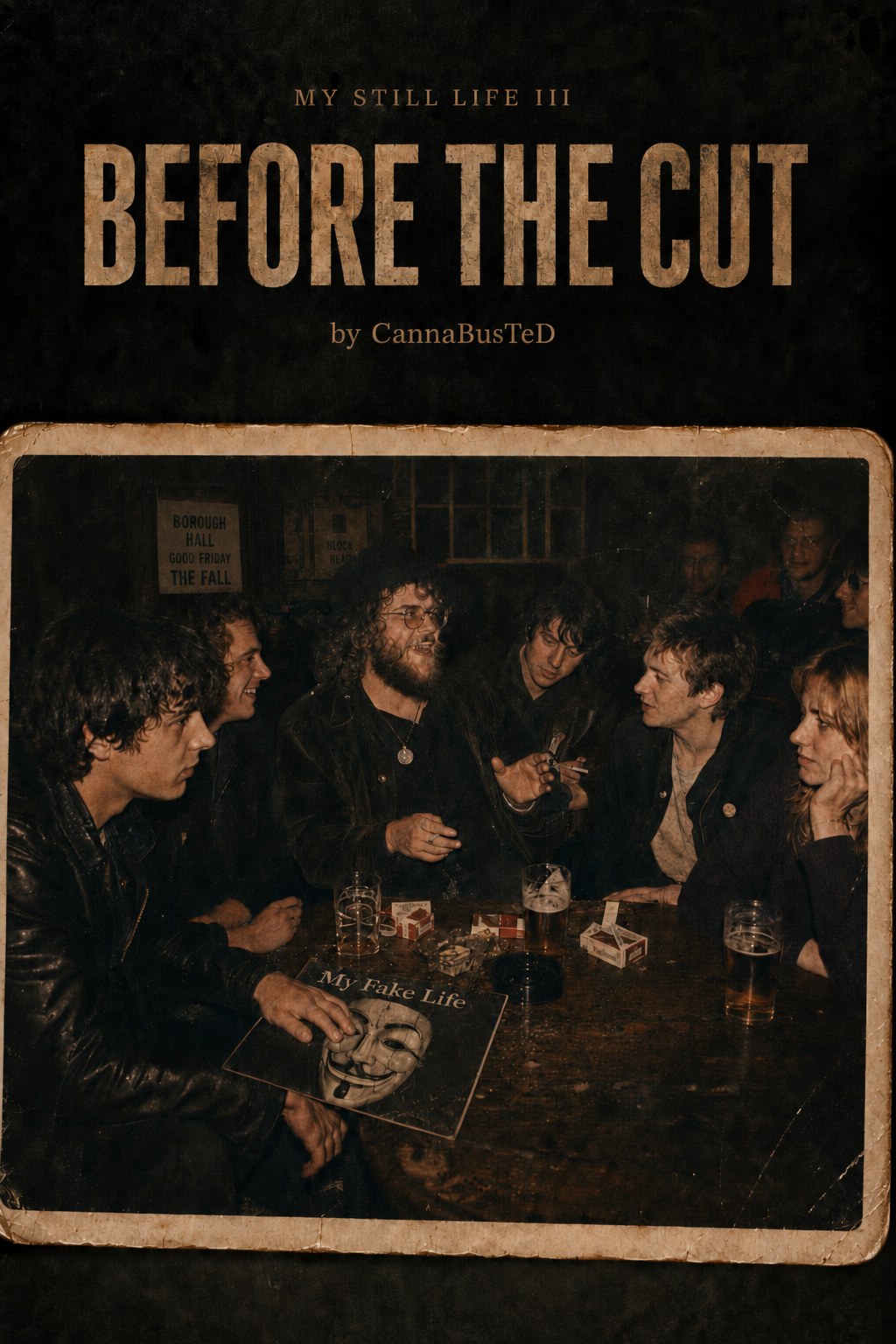
MY STILL LIFE III
Before the Cut
by John Small

My Still Life · Book Three
John Small
Page 1 of 139 · 1% read
Before the Cut
by John Small
Before
John
I left school at the first chance they gave me and I've not missed it. What I know, I know off two men.
My granddad had me in the boat from about seven. Not helping. Just in it, out the way. You learn the water by being bored on top of it for years, and then one day you aren't learning it any more, you just know where it's going to do a thing before it does it, and you couldn't tell anybody how.
And my dad, who I don't think said four hundred words to me in his life, and every one of them was worth having.
He taught me to build a fire. Properly. Small first. Give it air. Don't touch it once it's going.
Most people kill a fire out of enthusiasm.
By twenty-two I had a boat with my name in the harbour book and a hand that had stopped bleeding when it was cold. Split knuckles all through the first winter and then they just went hard and stopped.
Nobody tells you that happens. You wait for the pain to stop and instead you stop.
I was never the best on the water and I knew that by nineteen. What I was good at was engines, and paper, and telling straight off which of the two a problem was.
If a thing wouldn't start I could start it, and if a thing wouldn't add up I could add it, and there's not many down there who'll do both. The ones who will end up in an office in the finish whether they fancy it or not. I've ended up in one. I'll come to that.
I got up at four. I liked it. You aren't supposed to say that so I didn't say it.
There's an hour out there before it's properly light where nothing has started yet. Not the day, not the town, not anybody.
It's only you and a diesel engine and the sound of water on the side of a boat. I wouldn't have swapped that hour for anything anybody has ever offered me since.
That was going to be it. Get up, go out, come back, do it again. I'd have done that until I dropped and I'd have thought I had a life.
I did think that. I'm putting it plain because of what comes after. I wasn't a man waiting for something.
I was finished. Twenty-two and settled like a man of sixty.
Then Sweetness.
That isn't her name. That's what I called her. I only said it out loud twice. She went mental both times, and both times I meant it more than I let on.
She was cleverer than everyone. Not in a way that she made you feel it. She'd read things and not mention it. Months later you'd find out she'd known all along. She'd let you have your say and enjoyed you having it.
She had a place at a university and a letter in a drawer, and the whole town knew about it before I did. I found out off a woman in a shop.
That's what it was like. She was getting out and it had been decided, and not by her. She let them do it. I think it sat heavier on her than anybody guessed.
She used to say it like it was a joke. Apparently I'm going.
I laughed at that for about a year. I've thought about it a lot since.
She was light. That's the only word I've got and it isn't the right one, but I've been looking for a better one for a long time and there isn't one.
She'd get an idea stood in a shop doorway and we'd be somewhere else inside the hour. She had me on a bus to the coast at nine at night once, for no reason she could give me afterwards.
We got there, it was black, you couldn't see the sea, you could only hear it. She stood there listening to it like it was a band.
I said, we could've heard that at home. She said, not this bit of it.
I've had a lot of years on that one an' all.
I'm a man who plants his feet. That's the whole of me. Everything I'm good at, I'm good at because I don't move about.
She had me off the ground for about fourteen months.
I don't know how else to put it. I wasn't walking anywhere, I was going along above it. Work was easier. The cold was easier.
I was civil to people I'd never been civil to in my life. My mother noticed and said nothing, which is how you knew she'd noticed.
I've never been back to that bit since. Not once, not for an afternoon.
I was going to go with her. That was my whole plan and I never said it out loud, not to her, not to anybody, in case saying it broke it.
She'd study and I'd get work, because there's work anywhere for a man who can lift and turn up. And I'd carry it.
Whatever it turned out to be. Rent, hours, the lot. She could do the clever thing and I'd do the other thing.
That was what I'd to offer. I knew that even then. I wasn't confused about what I was.
And I thought that was enough. It was enough. I've gone over it for years looking for the flaw and there isn't one.
That was a good plan made by a young lad who meant every word of it.
It never got said. That's all that was wrong with it. I kept it in my head where it was safe, the way you keep a rope coiled properly so it'll run clean when you need it, and I was going to say it that spring, and I didn't say it that spring.
I do not think about many things. I think about that.
Her
I was twenty-three. I lived above the Brunswick shops with a man called Jack and I'd just come out of hospital. That's where I am when this starts, so you know where you've got me.
The coat was denim and it wasn't warm. He wore it in all weathers. He was cold in it for four years.
I offered him a proper one once. Not as a dig. I'd one going spare. He was stood there with his hands up inside his sleeves like a child, and I said do you want this, and he looked at it the way you'd look at a plate of something you hadn't ordered. He said, it's not me though, is it.
He was twenty-one then. He'd worked out what was him and what wasn't him, and after that he was cold for four years rather than revise it.
And everything he did after came out of that same drawer. It wasn't cruelty. He had a list of what he was and he stuck to it and he'd have died on that hill and he nearly did.
He had a guitar and he was better at it than anybody knew, including him.
He'd sit on the end of the bed with it and work at one bit for an hour. Not a song. Four seconds of a song, over and over, until it went from a thing he was doing to a thing that was happening.
I could hear it through the wall at my mam's. I could hear when he got it, because he'd stop.
That's all I know about music, and I learned it off a wall.
He couldn't play in front of people. Not wouldn't. Couldn't. We'd be somewhere and somebody would say go on then, and he'd talk.
He'd talk over the top of the moment until the moment had gone somewhere else, and then he'd be all right again.
I used to think that was nerves. It wasn't nerves. He couldn't be seen trying. He could be seen having done something, and he could be seen not bothering, and there was nothing in between that he could survive.
He never once played in front of me either. Four years. Through a wall, hours of it. Never across a room.
I found out on a Tuesday because the Tuesday was when I could get to the chemist without anybody I knew being in it.
I didn't tell him for two days. For two days it was mine. I knew that the second I said it out loud it stopped being mine and started happening to both of us, and then to everybody.
So I had it on my own for two days, and I've never regretted a decision less.
When I told him he went completely still, which I'd never seen him do, and then he laughed, and it wasn't a good laugh at first. It was the laugh you do when you're catching up. And then he said, right.
And then about a minute later he said it again, different. Right. That second one was the best sound I've ever heard a man make.
Nine days. That's what I got. I've counted them more times than is healthy and I know exactly which nine they were, and I'm not going to list them.
He was different in those nine days and I've spent a long time deciding whether the difference was real. I've decided it was.
He got up. He went and asked about hours at a place he'd been slagging off for a year. He put the guitar in its case at night instead of leaving it out, which sounds like nothing and wasn't nothing.
And he talked about it. He was a lad who didn't say things and he said things. He said he wanted it to be able to swim.
Not could swim — able to. He'd thought about the difference.
I've got nine days of a man being exactly what he could've been. Most people don't get nine days. I know that.
People have said that to me like it's a consolation. It's the opposite of a consolation. Now I know it was in him.
The cot came from a house on the other side of town. Pine, secondhand, thirty pound, and the woman selling it was so glad to see it go that she knocked five off and then stood in the doorway watching me carry it down her path.
Jack was working. That isn't a criticism, he was working, it was the first Saturday he'd worked in a long time and I was the one who told him to take it.
I got it home on the bus in two goes. The ends went on first and I came back for the base and the bag of bolts.
And then I carried it up the stairs on my own.
Thirty-one steps, turn halfway, catch the corner of the frame on the way round because everybody does. I stopped halfway up with it on my knee and had a bit of a sit down and a laugh at myself, on my own, on my stairs, with a cot.
And I was happy. I know what people do with that bit — they want it sad because of what comes after, and it wasn't sad.
It was one of the best hours of my life and I was on my own for it. Both of those are true. Neither one spoils the other. I got it to the top and stood it in the little room and it filled about a third of it.
Then I went down and put the kettle on and sat looking at the ceiling.
Ted
I was forty and playing to twenty-year-olds in rooms with a fruit machine in them, and I had a van, and I'd worked out how to say all that in a way that sounded like a choice.
I was good at that. I've always been good at that. Give me a bad fact and half a minute and I'll hand it back to you as a philosophy.
The cardigan was green and it had gone at both elbows and she wouldn't have it mended.
She said mending it would be a lie about how long she'd had it. I said that was the single most pretentious thing anybody had ever said in this town, and she said, and yet.
That was Ness. And yet. Two words, forty seconds after you thought you had won, delivered while doing something else.
People get her wrong. They've been getting her wrong for thirteen years.
She wasn't shy. She wasn't fragile. She wasn't one of those quiet lasses who needs bringing out of herself, and I've wanted to throttle several people who have described her that way to my face.
She was on her own a lot because she preferred it. There's a difference between the two and almost nobody can see it, and she'd spent her whole life being pitied by people who couldn't.
She used to say the only lonely person in any room is the one going round checking nobody's lonely.
She was looking at me when she said it. I laughed. I didn't think about it again for years.
She wrote things down in a notebook with a rubber band round it and wouldn't let anybody read them. Once a month she'd read one out with no warning, usually while you were doing something else, usually badly on purpose so it didn't count. I should say first that she was filthy. People forget that when somebody dies. They tidy them.
She was filthy and she was loud with it, and she had a way of describing men she didn't rate that I'm not going to put down here because my mother might read this. She heckled. Not me — she'd never once heckled me, which I took as respect and was probably mercy. But she'd take on a fella doing a poem about the moon and she'd do it while he was still going. That's not what the moon's like. Out loud. In a room. With her drink in her hand and no ego about it whatsoever, because she wasn't performing, she just thought he'd got it wrong and somebody should tell him.
Then she'd read one of hers out badly and sit down.
The pigeon. That's the one.
Somebody had picked a dead pigeon up off the pavement, put it in a paper bag, and stood it by a bin. Neat. Folded over at the top.
And the poem was about the folding over. Just that. Somebody stood on a wet pavement in the rain taking the trouble to fold the top of a bag over on a bird that was already dead.
I laughed. It's funny, that. It is genuinely funny, a pigeon in a Greggs bag, and she knew it was and she let you have it, she gave you a good thirty seconds of it.
And then she did the last two lines.
He'd been dead about a day by then. Somebody had still made him tidy.
I can give you those two. I've lost the rest of it and I'd give a great deal to have it back, and the reason I've lost it is that I was too busy laughing to listen, which is the truest thing I know about myself.
I made her do it again in a pub, twice, and she did it both times, and she watched me the whole way through.
She was eleven when her dad was killed. A bus, out on the ring road, on his own, and it was quick, and I only know that much because I only ever asked once.
I didn't put those two things together for a very long time.
Actually that isn't true. I've never put them together. I'm telling you now because I can hear how it sounds, and I still don't feel it, and I'd rather admit that than pretend.
I performed at everybody. Barmaids, blokes on the door, my own mother. There wasn't an unguarded hour in me. I couldn't be still in a room without turning it into a thing that was going well.
And she didn't join in.
That was it. That was the whole trick and it took her about a week to find it. She'd let me do four minutes, and then she'd ask me something so plain that there was nowhere to go with it, and I'd be stood there holding all this material with no room to put it in. She'd say, but do you like doing it though.
And I'd say yes. Not the funny version. Just yes.
Do you know how few people can get a yes out of a man like me. One. That's the number.
We weren't together in a way that'd satisfy anybody who wanted a story about it. There was no anniversary. There was no moving in.
There was a green cardigan on the back of a chair in my flat for four years and neither of us ever said a word about what that was.
I've been asked about it since by people being kind and it's the one subject I can't do a bit about, so I change it.
She'd come to the gigs and sit at the side and not watch. That's the thing I loved most and I've never said it to anybody.
Everybody else in the room watched. She'd sit sideways on with a drink and listen, and she never once told me a song was good.
She told me when one was true. Different word. She used it about four times in four years and I could recite all four to you now.
That spring, before anything, I thought I was a man who had got away with it.
Forty, no money, no house, van, four songs that worked out of about ninety that didn't, and a woman cleverer than me who let a cardigan live on my chair.
I thought I'd beaten the whole thing. I honestly did. I thought everybody else had gone and got themselves a mortgage and a manager and I'd somehow slipped out the side door with the only bit worth having.
I used to say that out loud. In pubs. To people who were being polite.
And the thing is I was right. That's what nobody believes when I tell them. I was completely right, and I had it, and I knew I had it, and there isn't one single thing I'd go back and do differently in those four years. I just didn't know it was four years.
Good Friday
John
She asked me to stay out and I said no. I've had that conversation more times in my head than I've had any real conversation in my life, and it went like this, and I'm not softening it.
We'd been to the Borough Hall. For thirteen years this town has had me sat at home that night like a man who wouldn't take his lass anywhere.
I took her. I paid a fiver each on the door, which was a fiver. Then I stood at the back of that hall with my arms folded while a band she'd read about somewhere went at it. I didn't know one song. I clapped in the right places and she kept turning round to see if I was enjoying it.
I was enjoying it. Not the band. Her turning round. That's the last good thing that happened to me and I'd have to say it was a canny night out.
They turn the Borough Hall out at nine on a Good Friday because it's the council's and the council doesn't do Good Friday. So we came out onto the top of the town at nine o'clock with about two hundred other people and everybody stood about the way they do when a thing's finished too early, and word went round that the band were going down the Brus. And she looked at me. She said, come on.
I said I'm up at four. She said you're always up at four. I said that's because the fish are always there at four. She laughed. It was the sort of thing I said and she'd decided early on to find it funny, and that was the end of it.
Eleven seconds. I've timed it since, out loud, in a kitchen, like a lunatic.
She wasn't annoyed. For a long time I told myself she was annoyed, because annoyed would've meant she wanted me there, and it turns out I'd rather she'd been annoyed with me than fine about it.
She was fine about it. She said she'd see us tomorrow and she went off down with the rest of them.
I walked home the other way. It's about a mile. I remember it being mild.
It was Good Friday. I only know that for certain because of the boat.
Everything shifts round the bank holidays. What you can land, who's buying, when the ice comes. I had it worked out on a bit of card in the wheelhouse and I'd gone over it twice that afternoon.
That's what I was doing. That's genuinely what I was doing. I had a cup of tea when I got in. Went over the card again for no reason. Put my alarm on. I was asleep by half ten, and I have never been able to get past the fact that I slept well.
Saturday I worked. Good day, as it goes. Sunday I did nothing, which was normal for a Sunday, and she didn't come round, which was also normal, or normal enough that I didn't stand in the kitchen thinking about it.
I thought about it for about four seconds on the Sunday night. Then I went to bed.
She came to the door on the Tuesday.
She'd been crying a long time before she got there. You could tell by the breathing more than the face. She said, I've done something.
And then she said, I'm so sorry, and she said it about six times, and each one was worse than the one before it.
And she couldn't look at me.
That's the bit. Not the words. She'd looked at me every day for over a year, straight on, that was her, and now she was looking at my step. I said, done what.
And she opened her mouth and nothing came out of it.
I've had thirteen years to consider what was stood behind that mouth. She was twenty years old on my step trying to get a thing out and couldn't, and I didn't ask again.
I did not ask again.
What happened in me was this.
The chest went first. Like the floor of it dropped out, the way it does when you go down a step you didn't know was there.
Then the stomach turned right over, proper, the way it does on a bad swell when you've got no warning of it.
Then a lump came up in my throat that I couldn't get past. And my eyes went hot.
I was twenty-two and I'd never cried in front of anybody in my life. Not at school. Not at my granddad's. Not once.
And what I wanted to do was sit down on my own step and howl like a bairn, get hold of her coat with both hands and put my face in it and make a noise I have never in my life made, not once, not at my granddad's, not in the boat, not anywhere, and I could feel it coming up out of me like water up a hull and I had about a second and a half before it was out and everybody on that street had heard it, and there was a woman two doors down at her window, there was, I can see her now, and I could not, I could not do it in front of her, I could not do it in front of anybody, I could not —
And I heard my dad.
Not his voice. He wouldn't have said it. Just the shape of him, stood at the end of a jetty, not saying anything.
Get a hold of yourself. Don't be soft. Don't let it get hold of you, because if you let it get hold of you it'll have you. So I got a hold of myself.
I said, go on, then.
And she couldn't. She got about three words in. There was a. Then stopped. Looked at my step. Started again, and stopped again.
The next bit is the only part of this I've never let myself have. I wanted to know.
I'm not a man who leaves a thing half-done. If an engine's making a noise I'll have the cover off it before I've had my tea.
I wanted to know what it was and I wanted it more than I've wanted most things, and I had my mouth open to ask her again. And I worked out, in about a second and a half, what was likely stood behind it.
Because I'd have taken it. That's what nobody has ever understood about me, including me, for thirteen years.
If she'd got it out — whatever it was, whoever it was — I'd have stood there and taken it. I'd have had her in the house and the kettle on inside five minutes. That's what you do. She was mine and she was in a state on my step.
But there'd have been a thing in me after. Some little hot bit of it, down the back, that I'd never have got out again.
I knew that stood there at twenty-two. I knew it the way I know weather.
And I'd have been decent to her every day for forty years with that thing going. She'd have felt it. It would have ruined the only good thing I had, slowly.
And I'd have called it forgiving her. So I never asked.
I did not ask again.
I said: don't.
I said don't tell us. And she said my name. Just my name, that's all she got out. She put her hand out and got hold of my sleeve.
I've had that hand on my sleeve for thirteen years.
And I couldn't stand in that doorway another second. So I took my coat off the hook and I came out past her.
That's the bit the town never got.
I didn't put her out. I never said a word about going and I never shut a door in her face. Everybody has had me slamming it and I've let them, because what I actually did doesn't sound any better and it takes longer to say.
I left her stood on my own step and I walked down to the harbour.
She said my name again behind me. Once. I didn't turn round. I didn't turn round because if I'd turned round I'd have gone back.
I sat in the wheelhouse in the dark for about three hours.
Didn't start her. Didn't do anything. Sat there with the tide coming in and that hand on my sleeve, going over it. Every road I went down came out at the same place. I could have her, or I could have the thing she was going to tell me. I couldn't have both.
I came back up about eleven and the step was empty and the street was empty and I let myself in like a man coming home from work.
I lit the fire.
Small first. Give it air. Don't touch it once it's going.
And I sat in front of it and I didn't cry. I was proud of that. I've never been proud of anything so stupid in my life.
I got up at four the next morning and I went out and I did a full day.
Here's what I've decided, and I've had a long time to decide it.
If I'd gone to the Brus that night, none of it happens.
That's it. I've not got any further with it than that. Eleven seconds on a street and a bit of card in a wheelhouse and the fish are always there at four.
I was not a bad lad. I've never been able to work out what I was instead.
Her
I didn't want to go and I went because everybody had started using the word out at me.
Get yourself out. You want to get out, you. She wants getting out, that one.
Six weeks of being handled. My mam doing the voice. Jack being careful with me, which was worse than Jack being useless with me, because careful wasn't something he'd in stock and you could see him going and getting it.
So I went out, to shut them up, in a top I'd to check still fitted.
The Brus on a Good Friday, which meant Sunday hours, which meant everybody in early and everybody out at half ten and everybody knowing it.
That does something to a room. It isn't a normal night. There's a clock running and every person in there can feel it, so it all comes on too fast — the drinking, the shouting, the being pleased to see people you aren't that pleased to see.
The turn was setting up in the corner by the fruit machine. One bloke, on his own, with a guitar. Older than you'd expect.
Kids watching him plug in like he was doing surgery.
Jack said, he's been going round for years, him. Jack said that about everybody who had ever done anything.
The jukebox was on before they started and between the sets and after.
Prince. The nineteen ninety-nine one, which everybody in that place had decided was theirs that year, and they sang it at each other rather than along with it, which is a different thing and a worse one.
And the Cher one. The one where her voice goes funny. It had been out for months and it was still on every jukebox in the country. There was a bloke at the bar doing the voice into his pint glass and his mate hitting him. Somebody said it sounds weird.
Somebody else said it's meant to. That was the conversation. It moved on and so did everybody else.
About quarter past nine the door went and half the town came in at once.
There'd been a proper band on at the Borough Hall — early finish, because the council won't have it going past nine on a Good Friday — and rather than go home they'd all come down the bank. The bar went three deep. The bloke in the corner put his guitar down and waited, and I remember thinking, well, that's his night finished.
It wasn't. He got them back. I'll give him that much and no more.
And she came in with that lot. Off the Borough Hall, in the middle of a crowd, laughing at something somebody had said behind her.
She was stood by the pillar with three or four others and I watched her for the rest of it. I've never admitted that to anybody. Here's why I did it. Because she was lovely, and I wanted to find the bit that wasn't.
I was six weeks off a hospital ward. I was twenty-three and I wasn't a nice person that spring. I'd started collecting evidence against people.
It's a thing that happens and nobody warns you about it. You go round a room quietly building a case against women you've never spoken to. It's disgusting. I did it, and I'd have denied it at the time.
So I watched her, and there was nothing.
Honest report. There was nothing to get hold of.
She wasn't the best-looking girl in there and she was the one everybody kept drifting towards. You could see it happening. People would come over for a minute and stay for ten.
She listened with her whole face. I can't put it any other road. When somebody was talking to her she wasn't waiting, she was in it, and you don't see that much in a pub at nine o'clock.
She had a drink she wasn't drinking. Same one all night, warming up in her hand.
An older woman came in selling raffle tickets for something and got to that group. The lads did the thing where they look at the ceiling. She bought a strip, asked the woman what it was for, and then asked a second question about it. A second question. To a raffle woman. On a Friday.
I remember thinking, you're twenty and you've got manners like a person of sixty.
I didn't mean it kindly. I was in a state and that's what it looked like.
Somebody said she was off to university in the autumn. Somebody else said, aye, well, she'll not come back, will she, and there was a little bit of a silence round that, because everybody agreed and nobody wanted to be the one who had said it.
And she laughed and said something like, I might, you never know, and let them have it.
That's what she did all night. Let people have it. Let them have their bit, their joke, their opinion about her own life, and carried on being pleasant, and I couldn't tell you now whether that was kindness or whether it was a lass who had never once been asked what she actually wanted and had got so used to it she didn't notice.
I've thought about that more than is reasonable.
I talked to her.
It was in the queue for the toilets and it lasted about ninety seconds and it was about nothing.
I've gone at that memory for years like a man going at a knot with cold hands. I can't get it open.
I know it happened. I know we both laughed at some point. I know she said something about the state of the door.
That's it. That's what I've got. The state of the door. I'd give a great deal to have paid attention.
Half ten and the lights came up and they turned us all out.
And nobody went home. That's the bit. The night hadn't finished, it had been stopped, and there were forty-odd people stood on Northgate at twenty-five to eleven with nowhere to be and nothing decided. Somebody said the allotments.
The older fella who'd played first had a shed up there and it was apparently a thing. Half the room seemed to know it was a thing already. Off they went up the road, thirty-odd of them, like it was a trip.
I didn't go.
And you'll want a reason for that, so here they are, and none of them is good enough, and I've known that for thirteen years.
I was cold. My chest ached, which it did for months and nobody had told me it would. I'd been out for one night six weeks after the ward and I'd done it. I'd stood in that room and been looked at and been kind about it. I wanted to sit down somewhere with a door I could shut.
I said I was off home. Jack said right. That was the length of it — not a row, we didn't row, he just said right and turned his head to see where everybody was going. I said, are you coming.
And he said, in a bit.
So I stood on the corner and I watched them go up the road.
Thirty-odd of them, loud, somebody carrying a bag with cans in it, somebody running to catch up. Jack about four back from the front with his hands in the denim jacket.
And her. She was in that crowd. She was near the back with the drink she still hadn't drunk, laughing at something somebody had said, walking backwards for a few steps the way you do when you're twenty and it's a Friday.
That's the last time I saw her upright and well.
I didn't say goodnight to her. We weren't friends. We'd queued for a toilet together.
I walked back along Northgate on my own and up the thirty-one steps. Sat down in my own front room with my coat still on. And I was pleased with myself.
And before anybody makes that sad an all — I was pleased. I'd gone out, I'd been seen, I'd stood it, and now I was home before eleven with the door shut and the whole thing was behind me.
Jack came in at some point. I heard the bolt and I didn't look at the clock and I went to sleep.
I've been through that night since looking for it and it isn't there.
There's no moment. There's a warm pub and a raffle strip and a lass being polite to people who had already decided what she was going to do with her life. A bloke doing the voice off a record into a pint glass. Me stood in a queue for a toilet not listening.
And then there's a corner on Northgate where I turned left and everybody else turned right.
Everybody who was there says the same. It was a good night.
I wasn't there. That's what I've had thirteen years to sit with. Whatever it was that got into my house, it didn't come in with me. I was already in bed.
It was a good night, they all say. I'll have to take their word.
Ted
Four songs.
Not four good songs. Four songs that worked, which is a different thing and it's the only thing.
I'd been doing that room for years and I knew every dead spot in it. There's a corner by the cigarette machine where you lose them and there's nothing you can do about it, and there's a spot two feet left of where they put me where the whole thing suddenly sits up.
I found that spot at about nine o'clock and I didn't leave it.
And then at about quarter past nine the door went and the room doubled.
They'd had a band on at the Borough Hall and the council had turned them out at nine like they always do, and about forty of them came down the bank to us with the night still in their hands. Kids, mostly. Half of them had never been in the place.
Now that's a thing that can finish you. You've got a room worked out and somebody empties another room into it.
I put the guitar down and let them get served. Ten minutes. You cannot play at a bar three deep and only a fool tries.
The fruit machine went off in the middle of the third one.
You won't know what that is unless you've stood in one of those rooms. It isn't just noise. It's a machine designed by a professional to take a room off you.
Bells, and then that run of notes, and then the coins, and the coins go on and on and there's a lad going yes over the top of it.
And I kept going.
I didn't stop and do a line about it, which is what I'd normally do, because doing a line about it's admitting it beat you. I just kept going into it, quieter if anything, and I watched them go.
They all went. Every one of them turned round and looked at the fruit machine and the lad and the coins. I was stood two feet left of the spot playing to nobody. And then they came back.
That's the best I've ever felt. In my life. Including everything.
Not the song. The song was all right. The coming back. There's about a second and a half where you can feel a room decide.
They decided. They turned back round and they were mine again, and mine harder than before, because they'd gone and chosen it.
I'd have done another forty years for another one of those. I didn't get another one of those.
She was in. Down the side, sideways on, the way she always was, with a drink and her back half to me, listening and not watching.
I came off, got a pint, went down to her. She said:
That third one was true.
Four words. She'd given me that word four times in four years and I knew what it cost her to hand it over, and do you know what I said?
I said cheers.
I said cheers, and I looked over her shoulder at the room, because the room was still going and I wanted to be in it.
She didn't mind. She never minded. That wasn't a woman who needed me sat down in front of her.
She went home at about ten. On her own, up the road, in the green cardigan, and I didn't walk her, and there was no reason on earth why I'd have.
I've gone over that pint about a thousand times since. The thing that gets me isn't that I said cheers. It's that I turned round. I've got no idea what her face did.
Then there was the lad with the questions.
They come up after, some of them, and mostly they want to tell you about their own band. This one didn't. This one had actually listened, which is rare enough that I gave him the time.
He wanted to know about the end of the third one. He'd clocked that it doesn't resolve, it just stops, and he wanted to know how you get away with that.
Denim jacket. Cold night, no coat over it. Talked fast, and kept looking at the door while he talked, the way some of them do.
So I told him. Don't fade it and don't soften it and don't put four bars on the end apologising for it.
You take it out on the beat and you leave them in it. And he said, right, and he meant it, and I thought: there's one who might actually do something.
I liked him. That's where it starts and I can't get round it. I liked him and I told him to come up to the shed.
They turned the lights on at half ten and threw the lot of us out, which they did on a Good Friday, and the street was full of people who weren't finished.
A town's never louder than that. Forty people on a pavement at twenty-five to eleven, every one of them waiting for somebody else to say where.
I said where.
I've spent thirteen years not writing that down plainly, so there it is. Nobody talked me into it.
I was still up from the room and I didn't want it to stop. I said come up to mine. About thirty of them came.
The allotment was the only thing I've ever owned outright.
Shed, burner made out of a drum, crates, a bit of carpet. I'd had people up there a hundred times and it had never been a problem, and I'd have told you that with my hand on my heart at half past eleven that night.
It's black up there. Allotments are like that. Twenty feet from the fire it's properly black and it goes on for rows. There's always somebody wandering off and coming back. Nobody counts. Nobody ever has.
I didn't count. There's no version of that night where I count. I'd rather say it than have anybody think I've been up all these years torturing myself over a thing a normal man would've done, because a normal man wouldn't have counted either.
I was on a crate by the fire doing what I do.
The lad came and sat next to me late on. He'd had a lot by then and he wasn't doing the fast talking any more. He told me his lass had lost the bairn.
Not lately — six weeks or so. And that there wouldn't be another one, that they had been told that properly, in a room, by somebody with a folder.
And then he said the thing that I've never repeated to a living soul until now. He said it felt like a gate had come open.
He said all he'd ever wanted was the music and now the road was clear. He hated himself for the shape of the feeling. He was frightened of himself for having it. And he asked me what to do.
I had a woman across town in a green cardigan who thought I was worth the word true, and I'd had the best night of my life about two hours before, and a lad who could actually play was sat next to me asking a man of forty what to do. I gave him the best answer I had.
I said a man only gets the one go at it. I said don't let your dream die in that hospital as well.
I said if you stay you'll punish her for it every day of her life and you'll call it love. And she'll know. And she'll never be able to say what it is she knows. And I said, better one clean cut than a long blaming.
I said, seize the thing. Go.
I meant every word.
I've gone back at that from every angle and I can't get it to come out as a cruel thing. He asked.
He was in a state. I told him what I believed, and I believed it, and I still can't work out which part of it is the wrong part.
He nodded and he didn't say anything for a bit and then he shook my hand.
Nobody had ever shaken my hand before. Not for something I'd said.
I thought: that's the best thing I've ever done for anybody.
There was a young lass by the burner not long after, sat on a crate on her own, and I did a couple of minutes at her because I was still going and I couldn't stop.
She laughed. They mostly laugh. I couldn't tell you at what.
I offered her the joint the way you'd offer somebody a chip.
She took it and made a right meal of it, coughing. Everybody round the burner laughed and she laughed. She said something about never having had one and I said something back that got a laugh an all.
And that was that. I moved on round the fire because there were people at the other end I hadn't done yet.
That's all I've got. I couldn't tell you her hair, her voice, or one word she said. I can only tell you it happened at all because I've had to go back and count what I did that night. It's on the list.
It was a Friday. I gave a young lass a smoke at my own fire in front of thirty people.
It's a man handing something round. I've done it a thousand times.
I went down to the van at some point after one because the noise had gone thin and there were only a dozen left and I couldn't be bothered turning them out.
I slept in that van more than I've ever admitted. It wasn't a hardship and it wasn't romantic, whatever I've told people since.
But that night I didn't sleep in it because I had nowhere. I slept in it because I didn't want the day to start.
I woke about six with the light coming through and my neck ruined and the whole thing still sat in me. The fire was out.
There was nobody up there. Somebody had put the crates back, which I remember thinking was decent of them.
I want to put this down because I've had a lot of years to get sentimental about it and I've decided not to.
I was forty. I had no money, a van, and four songs that worked. A woman across town had used the word true about me the night before. I'd been in a room that came back. I'd sat by my own fire and given a frightened lad the truest answer I had in me.
A man is allowed one night where he was right about himself.
I've had mine.
I did everything right that night.
That's what I can't get past.
The drummer
I'll tell you the honest truth about all of it, because I've got no reason not to and because people always want it to be more interesting than it is.
It's brilliant. It's absolutely brilliant. Anyone who tells you it isn't is either lying or they weren't very good at it.
I've been at it since I was seventeen and the good part has been these last thirteen years. I've played to seventy thousand people in a field in Denmark and I've had a bloke cry at me in an airport and I've got a house with a room in it I've never sat down in.
And I'd do it again. I'd do all of it again.
The only thing nobody says is that it doesn't fill up. That's all. You'd think it would and it doesn't, and you find that out in a lot of hotels.
But I'm not complaining. Put that down. I'm not one of those.
We were nobody then. People forget that.
We were four lads in a Transit doing three hundred quid a night when we could get it, and we did that Easter run up the north east because our fella could get us the money, and one of them was a council hall in a town nobody in the van had heard of.
I couldn't have told you the name of the town the week after. I know it now, obviously. I know it very well now.
We did all right. Two hundred-odd in a hall that holds more, which is fine when you're nobody, and we were loaded out by nine because the council turn you out on the dot and there's a fella with keys stood tapping his foot.
And then you've got a night in front of you and nowhere to be. Nobody tells you that bit about being in a van at that age. The gig's the short part.
Somebody said there's a pub down the bottom does music.
So we went down as punters, four of us with our hands in our pockets, and there was an old fella on in the corner on his own with an acoustic.
I'll be straight with you, I thought oh God, here we go.
And he was good. Genuinely. He had that room in his hand and it was a room full of people who'd not come to listen to anybody.
He had them going in about four minutes, and we'd just done our hour to a hall that clapped politely between songs, and I stood at the back with a pint feeling about an inch tall.
You never forget the ones who are better than you in a room where it doesn't count.
She was the best-looking girl in that pub by a distance and she came and talked to me first.
Not because it excuses anything — there's nothing to excuse — but because that's what happened and it's the bit I've gone over the most.
She'd been at the hall. She'd seen us on. She came over and told me so. She was about the only person in that pub who knew we were a band at all, and when you're twenty-seven and nobody, that's the whole world for a minute.
She was clever. Really clever. She was clever in a way that made me feel about nine. She was funny. She was going away somewhere in the autumn and she said it like she was apologising for it.
I've met a lot of people since. Genuinely thousands. I remember her better than nearly all of them and I've had a long time to work out why and I think it's just that she was kind to me before anyone had any reason to be.
I never got her name. Or I did and I've lost it. That sounds terrible. It is what it is.
Then it was chucking out and somebody said about going up the allotments and about thirty of us went.
That's a night, that. I'd never seen anything like it. Sheds and a fire in an oil drum and lads bringing carrier bags out of hedges. The old fella up there holding court. Black in every direction, because there's nothing behind an allotment except more allotment.
I got talking to a lad in a denim jacket about guitars. That's Jack. That's where we got Jack, that night, standing next to a fire.
He came down to us six weeks later with a bag and that was that. Four years he was with us. Very good, an' all. It didn't work out for him in the end.
Funny how much comes out of one Friday.
She was up there. She'd come up with the rest of them.
Somebody gave her a smoke. I didn't see whose hand it came off and I've never been able to put a face on it, and I've tried, because you do.
She made a proper show of it. Coughing, everyone laughing, her laughing, and she said something about never having had one, and I remember thinking, at twenty-seven, that that was charming.
She went quiet after that. I noticed. I did notice.
I thought she'd relaxed. That's what I thought at the time, hand on heart. I thought: she's gone all soft and quiet, she's having a nice time.
There's a path down the side of the sheds with gravel on it.
She kissed me. She kissed me first, on the path, and I've never once been unsure about that, and I've had thirteen years to be unsure about it.
And then it was a fence and my jacket half off and it was, if I'm honest, not my finest hour. I've made a joke of it before now. Two minutes and a splinter. People laugh.
She said no.
She said it quiet and she said it more than once. She didn't push me off and she didn't shout and she didn't go anywhere, and it wasn't like that, it wasn't a thing where somebody's shouting, and she'd kissed me first, she had, and she'd been talking to me all night and laughing at everything I said, and I'd worked out what sort of a night it was going to be about two hours before, and if you'd stopped me then and asked me I'd have said she was as into it as I was.
So when she went quiet and went stiff on me I put it down to shy.
Because that's what I wanted it to be. And it fitted.
I heard her.
That's the sentence. Thirteen years and I can't get it any smaller than that.
I heard her and it didn't stop me.
I did up her coat after. It was freezing and she wasn't doing it.
And she was crying. Not making a noise. Just going, the way people do when they've been holding it and it's got past them. I stood there on that path like a spare part and said what's the matter.
And she said a name.
She said: John.
And she went back up the path on her own.
I never found out who John was.
She'd a lad, obviously. She'd a lad and she'd had a drink and she'd gone and done something daft, and the second it was done she was straight back to him in her head. That's why she went. That's why she cried.
That's what I've settled on. Settled on. Not worked out.
There's two other ways it goes and I've never been able to put them in order. Either she went off me. Or I did something that made her go off me.
Thirteen years to rank those three, and every time I get near it I put it down and do something else.
She went back to her lad. That's the one I keep.
It's the only one where nothing was wrong with the night.
I looked for her about half an hour later and she'd gone.
I was a bit put out, if I'm honest. I thought that was a bit off. We were on in Newcastle the next night and I remember being in the van thinking, well, that's that, and feeling like I'd been had.
That's the last thought I ever had about her for about four years. That she'd been a bit off with me.
It was Jack who told me she'd died.
Years later, in a van outside Bristol, and he wasn't even telling me, he was telling the bass player. Some lass off the Headland, twenty-odd, gone.
Drugs in the end. And there was all this stuff about a fisherman who'd turned on her and thrown her out, and how the town never forgave him. Jack said it like it was the saddest thing that had ever happened there. It probably was.
And I said, hang on. I said, I think I met her.
And Jack said, aye, you did, she was up Ted's that night.
And that was it. That was the whole conversation. We were on in forty minutes.
I've thought about her a lot since. Properly a lot. More the last year or two than I did at the time, which I can't account for.
Because here's the thing that gets me, and it's the only thing that gets me, and I'd never say it to anybody I know.
She was clever and she was funny and she was kind to me when I was nothing. She was going to go and do something. Then some lad she'd been seeing threw her out over God knows what, and she went to pieces, and that was her whole life.
And I met her right at the good bit. That's what I've got. I met her on the one night she was still all right. I've got about four hours of her. I've been in rooms with everybody you can think of since and I've never had a conversation like that again.
I do sometimes wonder. That's all. I wonder if that was the one, and I was twenty-seven with a van outside, and I didn't know what I was looking at.
I've had one marriage that didn't take and a lot of hotels. And I've got a memory of sitting on a flight case in a pub on a headland with a girl who laughed at me, and I keep it good. I keep it exactly as it was. I don't let anything near it.
If she'd have lived I reckon she'd have loved all this.
I'm here now. Daft, but there it is.
We're on at Sunderland tomorrow and it's the last one. The actual last one. I could have stopped anywhere between here and there and I've booked myself into a place on the front twenty minutes up the road from that pub.
I came up a day early. I told the lads it was the traffic.
I drove past the end of the street last night and I didn't stop. Went round the block like a burglar and drove back to the hotel and sat in the car park with the engine off for about twenty minutes, a man of forty, on the last tour of his life.
The pub's still there. The allotments are still there.
And I keep thinking: that's where I was happy. Right there. I never even got her name and there's not a single person alive I could tell about it who'd understand what I meant.
I'm going to go down to the beach in the morning before anybody's up. I don't know why. It's the only thing in that town I've got no memory of, so I suppose it's the only bit of it I can stand to look at.
After
John
She came back four times.
That's the part nobody knows and I've never told anybody, and I'm aware that telling it now doesn't help.
Twice at the door. I didn't open it either time. The first time I was stood on the other side of it with my hand flat on the wood, close enough that if the door hadn't been there we'd have been touching.
Once at the harbour. She came down and stood at the top of the steps in the wind, waiting for me to come up, and I stayed down in the boat coiling a rope I'd already coiled. Twenty minutes. It's a two-minute job.
She went eventually. They always do. That's what I've learned about people waiting for you at the top of steps.
And the fourth time she didn't come to me at all. She just walked past.
That went on for weeks.
Same time most evenings, up the far side of the road, not looking in.
And I'd stand back from the window so she couldn't see me watching her not look in. Back by the sideboard, out of the light, like a man in his own house hiding from a lass of twenty.
I could've opened that door any one of those times. It was a door. It opened.
I've never been able to explain, to myself or anybody, what it was that I thought I was defending.
She didn't go in the autumn.
That's when the town started paying attention, because that was the bit they had a stake in. She was the one that was getting out.
They had all been telling each other about it for two years.
And she didn't go, and there was no explanation given out, and I said nothing, because I didn't have anything to say, because I didn't know.
That's not me being modest. I didn't know. I've been accused of a great many things since and not one person has ever accused me of the right one, which is that I never asked.
I saw her outside the Brus the June after.
She had her sleeves down in June.
That's when I knew. Not what. I've never known what. Just that something had got hold of her and I'd let go of the rope.
She was with them by then. The band. The one that went on to do all right for themselves, and I've watched that happen from here, over years, on television in other people's houses, and I've never once said a word about it.
I couldn't tell you whether she was with him or near him. I've never wanted to find out and I couldn't tell you now which answer would be worse.
Her mam stopped me on Northgate that summer.
She wasn't nasty. I could've done with that, and she wasn't nasty. She said, will you not go and see her, John.
And I said, I don't think that'd help her.
And she looked at me for a good while, and she said, no.
Just that. No. And she went on up the road with her bag.
I've had that conversation with myself about four thousand times and I've never got a better answer out of it.
She died on a Monday.
I found out stood in a queue. Two women in front of me, talking to each other, not to me. One of them said her name and said what had happened. The other one said never. Then they carried on.
And I stood there and I paid for what I'd come in for.
I don't know what it was. I've tried to remember what I bought. It has gone.
I went out in the boat.
That's what I did and I know exactly how it sounds. I went home. Got changed. Went down and took her out and did a full day. Came in, landed what I had, did the ice, went home.
I've heard what people say about that. That it proves it. That a man who could do that had nothing in him in the first place.
Here is what I'd say to that if I ever said anything to anybody, which I don't.
There was nowhere else to put me.
If I'd stopped I wouldn't have started again. I knew that at twenty-two the way you know the weather. So I got up at four and I went out. The water didn't know anything about any of it. That was the only place on this earth that didn't.
The town made its mind up quick.
He turned on her and look what happened.
And they weren't wrong. That's the thing I've never been able to hand back over the counter. Something happened to that lass. She came to my door with it and I shut the door. Afterwards she was gone.
There's no arranging of those three facts that comes out well for me.
They got the wrong reason and they got the right answer.
Nobody ever told me what she'd done.
Thirteen years. Not once, not to my face, not drunk, not at a funeral, not by somebody trying to be kind and getting it wrong.
They all knew. I could see they all knew. It was in how careful they were and in how they stopped when I came in, and every single one of them thought I knew as well, because why would her lad not know.
And I couldn't ask.
Do you see why I couldn't ask? Asking would've meant saying it out loud — that she stood on my step and tried to tell me and I wouldn't have it.
That I didn't know because I chose not to know.
And by then not knowing was the only thing I'd left that looked like dignity.
So I never learned it. I've gone thirteen years in a town of eight thousand people who could all have told me in a sentence.
I didn't get over it and I didn't not get over it.
What actually happened is I got up at four the next morning, and the one after that. I did that for thirteen years and I got good at it. People round here will tell you I'm a steady man.
I am. That isn't a lie. It's just not the whole thing.
I've done well, an' all, if you want it on the record. Which is the joke. The office came for me the way I said it would.
I run the yard now — the boats, the berths, the lads, the paperwork with the big outfit at the marina who own more of it every year. Grown men wait on what I say about a lift and a tide.
I've got a good coat for meetings and I hate it.
And I've kept the boat. My own one, the little one, my name still in the book. I take her out on my own and I do nothing commercial with her whatsoever and I'd go without a wage before I'd sell her.
Everyone thinks that's lovely. A man who never lost the water.
Because I never let it get hold of me. I did what I was told. I got a hold of myself on my own doorstep at twenty-two years old and I've kept a hold of myself every day since.
I've been proud of that. Proud of it the way you're proud of a thing you can't stop doing.
Small first.
Give it air.
Don't touch it once it's going.
I built that in my own front room on a Tuesday night and I haven't put a hand near it since. It's been going the whole time. I only worked out what it was a very long way down the line.
You can't put a fire out by not looking at it.
Nobody ever told me that bit.
Her
He went odd after that Friday and I put it down to me.
That's what you do. You've been the problem for six weeks, everybody has been careful with you for six weeks, so when the man in your house starts coming in late and going quiet you think: right, it's still me, I'm still doing it.
He stopped working at the guitar. I should've read that bit and I didn't. Four years of four seconds of a song through a wall, and then nothing, and I was relieved, because I thought it meant he was getting up in a morning.
The note was on the side, under the tea caddy, four lines.
I'm not going to put all four down.
The last one said it was better one clean cut than a long blaming.
I remember standing there thinking: that doesn't sound like him. That isn't one of his. He was a lad who said it's not me though, is it, and here was a sentence with a shape to it, sat in my kitchen, in his handwriting.
I decided he'd been practising. That's what I decided, and I want it noted that I was right about everything except who he'd been practising with.
He took the guitar and he took the amp and he took the denim jacket and about nine other things. He did it while I was at my mam's. He was clean about it. Nothing dragged.
No mark on the wall where the amp had been because he'd put something over it.
He left the cot.
I've thought about that for a very long time and I've got two answers and they won't sit down together. Either he couldn't carry it down thirty-one steps on his own, or he couldn't carry it at all.
He was twenty-three. So was I.
The anger didn't come for about a month.
I was fine. Everybody said how well I was doing, and I was doing well. I went to work. I paid the rent on my own, which was a thing I'd never done, and I got a bit of a shine off it.
Then I dropped a cup.
Not a special cup. A cup. It went on the lino and it didn't even break properly, it just came apart in two big bits. And I stood there and something came up through me from the feet like water coming up a harbour wall.
So I put the rest of the set on the floor. Deliberately. One at a time. Looking at them.
And then I did the shelf they were on.
I sat in the middle of it afterwards for about an hour. Not crying. Sat.
That was the first one. There have been a lot since and I've never seen one coming.
I've read a great deal about all this over the years, quietly, the way you do, and every single thing I've read says the anger is the damage.
So that's what I've gone with. Thirteen years of thinking: that's the crack in me. That's where it got in. Everything else about me is fine. There's a fault running through it. It's red and it comes up through the feet.
Nobody has ever suggested to me that it might be the thing that kept me alive.
I'm only saying it now because I've had to say a lot of things in the last year that I didn't expect to say. I'm not sure I believe it.
I'm putting it down in case somebody else reading this is sat in the middle of a set of cups.
There was a lass died that summer. Twenty years old.
Everybody knew whose fault it was. It was that fisherman. He'd been engaged to her more or less, and he'd turned on her, put her out on the step over some carry-on, and after that she went the way she went.
I said it myself. I said it in a queue in a shop.
I said it with the full weight of a woman who had been walked out on, and I enjoyed saying it, and there was a bit of me that was glad there was a man in this town whose name was worse than the one in my kitchen.
I did a lot of that in those years.
It took me thirteen years and a Tuesday afternoon to find out I'd had it upside down. By then I'd said it to a lot of people, and you can't go round a town collecting a sentence back in.
The cot stayed in the back room eleven years.
I didn't look at it. That's what people get wrong — they picture me sat in there with a cup of tea being sad at it.
I didn't go in that room. It was where the ironing board lived and the boxes and the thing I'd for a while where I was going to do a car boot.
But it was in there. And every so often I'd be looking for something and I'd have to move it. I'd put my hand on the rail to shift it. That was the ceremony. About four seconds. Twice a year.
Eleven years is a long time to keep a thing you never look at.
There was a fire in the shop below.
It wasn't a big fire. Nobody was hurt, nobody jumped out of anything, the brigade were there in eight minutes and half of it was out before they arrived. Wiring, they said.
But smoke goes where it likes. It went up, and it went along, and it sat in the back room for a fortnight because the back room is where the vent is.
Everything in there was ruined. Not burnt. Ruined. There's a smell that gets into pine and it doesn't come out. I tried. I tried properly.
It went in a skip on a Sunday.
I've told people since that that was when I finally let go.
I've said it in that voice you use. It was time. Eleven years, and it took a fire to make me see it.
That isn't what happened.
What happened is that it was taken off me. I didn't decide anything. A wire in a shop I didn't own decided it. I stood in a yard in the rain and watched two lads I was paying thirty pound put my son's cot in a skip.
Then I went back up and put the kettle on and I couldn't have told you my own name.
I've never said that out loud until now.
The shop never opened again. It's still down there with the shutters half up and nothing in it, and I walk past it every day of my life.
I got the job at the café on Northgate that autumn, because the back room was empty and my head was empty and there's only so long you can sit in a flat above a burnt shop.
I've told people that the job sorted me out.
The job didn't sort me out. I'd already done the thing, badly, in the rain, about six weeks before, and the job was just what I did afterwards, and there's a great difference between the two that nobody wants to hear about.
I've been in that café two years now.
I know what everybody in this town has for their breakfast. I know who isn't speaking to who. I've poured tea for people who have said things about me across their own table that they think I didn't hear.
They don't know one thing about me. Not one. Not the nine days, not the thirty-one steps, not the skip.
And I let them not know it, and I've got very good at that, and I couldn't tell you at what point being good at it stopped being a thing I was doing on purpose.
I did not overcome anything.
And I'll say it before somebody else says the opposite, because people have a way of wanting you to be an example of something.
I got furious. Furious gets you up on a morning when nothing else will. I've never got a grip of it and it has cost me people. It has cost me people who didn't deserve it.
I kept a cot in a back room for eleven years and then a fire took it off me and I let everybody think it was me letting go.
That isn't strength.
I don't know what that is.
I know what I did after.
I got up, and I went in, and I did the shift.
Ted
Ness got ill in the September and she died in the March.
I'm not putting any more than that down. It isn't that I can't. It's that everything I've got is a bit, and there isn't a bit in the world that goes anywhere near it, and I'd rather hand you six flat words than stand here doing material over a woman like that.
She was thirty-eight.
The cardigan was on the back of the chair the whole time she was in the hospital, and it was on the back of the chair after. I've still got it. I've never mended it.
I stopped playing about a year later and I didn't notice for four years.
That isn't a figure of speech. I genuinely didn't notice. I didn't sit down one night and decide. What happened is I turned a couple of things down because of the van. Then a couple more because of my back. Then a fella rang me about a Saturday and I said I'd let him know and I never let him know, and then one day I was fifty and there was an amp under a bed.
I've got about nine reasons. Ask me in a pub and you'll get whichever one is nearest.
The room had changed. Nobody listens any more. It's all done on computers now. My hands weren't what they were, which is true, and which is also true of every man who has ever stopped doing anything.
They're all reasons. None of them is the reason. I know that much and I know nothing else, and I've not got any further with it in thirteen years.
I saw the lad once. Years after.
Up a ladder on Southgate with a bucket on a hook. He'd gone thick round the middle and lost most of the front of his hair. He was very good at it. Quick.
You can tell when somebody has done a thing ten thousand times.
I stood at the bottom of the ladder for a second like a fool.
He didn't look down and I didn't say anything. I went on to the shop, and by the time I came back out he'd moved up to the next one.
I heard he'd got somewhere for a bit. Somebody said a label, somebody said London, somebody said it didn't come off. I didn't follow it up.
I've thought about him maybe four times in thirteen years and every one of those times I've thought: well, at least I gave him a straight answer when he needed one.
A lass died the summer after.
I only mention it because I've been through everything else. Twenty years old, off the Headland, drugs in the end, and there was a lot of talk about the fisherman she'd been with and how he'd put her out.
I knew the name to nod at. That's all.
I didn't know she'd ever been up my allotment and there's no reason on earth I'd have known. I've gone at it since. There were thirty people up there that night and I could name you nine.
It was a Friday. I had a good gig and I said come up to mine.
I've taken that sentence apart more times than any sentence deserves and there's nothing inside it. It's a man asking people back.
I started painting because my hands wanted something and wouldn't have the guitar.
I was terrible. Terrible for about six years, and nobody encouraged me, and this isn't one of those stories.
But it's quiet. That's what I found out. You can't perform at a bit of board. It won't have it. You can do all your best material at it and it just sits there. After a while you stop. That's the first time in my life I've ever stopped.
So here's me at fifty-three, since I know how this reads.
A flat with a chair in it. A cardigan I won't mend. An amp under a bed and a guitar I take out about twice a year and put back.
No money to speak of. A handful of people who are pleased to see me and none who'd notice for a week.
And I'm all right. I'm not saying that the way people say it. There's no room to lose and nothing to come back from, and it turns out that after a lifetime of being brilliant in pubs I'm better at this.
I go up the dunes. Early, mostly. Before anybody.
Same view most times. West View, the works, the pier, the bit of beach that wants a fire in it and won't take one.
And low on the left, where the grass comes down off the dune, there's always a dead bit I can't solve. Something wants to be there and I don't know what.
Ted
Saturday.
I'm still going, if you can stand it. I said most of what I had yesterday and I've been up since five with the rest of it going round, which is what happens when you get a man of my age talking about himself. You don't turn it off at the tap.
So this is up at West View, first thing. The board's clipped and I've done the blue, because there's no way round the blue. And then I stopped, the way I always stop, because the middle of it was sat there empty and looking at me.
And a bloke came up the dune and sat down about six feet off.
I'll say now that I didn't know him from Adam.
Forty-odd. Good coat, better than anything on that beach. Sat down on the wet grass in it without checking, which tells you what the coat cost him.
He said, all right.
I said, aye.
And that was us for about ten minutes, and I'll be honest with you, I liked him for it. Most people who come up a dune at that hour want to tell you their uncle painted.
Then he says, are you not going to put anything in the middle of that.
Which is a better question than most people manage, and I looked at him properly for the first time.
I said I'd been trying to for nine years.
He said, trying what.
I said a fire. Two people sat at it. Small, down there, no faces, just the warmth of it. And I said the truth, which is that every time I put them in they come out false, because I've never in my life been able to invent warmth, and a board knows when you're at it.
He was quiet a bit. Then he said: so you're waiting for somebody to light one.
And I said aye. I suppose I am.
And he laughed, but not at me. He laughed like a man who'd just heard a thing about himself.
He said he was up with a band.
Sunderland tonight, the last one they were doing, and after that they were done, and he said the word done like he was trying it out for weight.
I said I'd played a bit myself, years back. The Brus, the clubs, all round here. I said it the way you say it when you're not after a fuss but you wouldn't mind one.
He said, oh aye.
And I said, were you ever up this way with it, in the early days?
And he said no. Never. First time.
And then he asked me something about the sky and we were off on that instead, and I let it go, because a man doesn't come up a dune at seven in the morning to be quizzed about old gigs by another old turn.
Then, out of nothing, he said: there was a lass.
He said it to the sea and not to me.
He said she was from round here. That she was cleverer than the lot of them. That she talked to him all night the once. That she was going away somewhere in the autumn and never went.
And that she died the year after. And that he's thought about her every year since and has never been able to say why.
Thirteen years, he said. And he said it like the number was the point.
I said I thought I knew the one he meant.
Because I did, or I thought I did. There was a lass off the Headland died about then, twenty-odd, and it went round the town for a year.
Drugs at the finish. And there was all that about the lad she'd been with, the fisherman — that he'd turned on her and put her out and never a word from him after. The town got behind that the way it does.
So I told him that. I told him what the town said, because that's what I had.
He didn't say anything.
Not a word. He sat there with his arms on his knees looking at the water. He didn't agree with me and he didn't put me right. After a bit he blew his cheeks out, the way you do when a thing's finished.
And that's the only four seconds of the whole morning I can't get flat.
Because most people, when you hand them the story of a town, they'll take it off you. They'll say aye, or that's terrible, or something.
He didn't do anything at all with it. He just let it sit there between us on the grass.
What I thought at the time — and I thought it quick, because a silence wants filling — was that he'd heard it all before.
He'd have asked after her over the years. He'd have got the same story off somebody in a pub a long time ago and he'd had it a lot longer than he'd had me.
You don't need telling twice about a lass you can't put down.
That's what I thought. I was pleased with it an all. It let the pair of us sit there.
He got up not long after. Brushed the sand off the good coat, too late for the back of it. Said he'd best get off, they were on at eight.
And at the top, where the grass gives out, he stopped and turned round, and he said the only thing he said that I couldn't do anything with.
He said: I hope you get your fire, mate.
And he went.
I've been sat here since.
The tide's about as far out as it goes. The light's doing nothing yet. The middle of it is still empty and I've not touched it.
Because there's something and I can't get at it, and it isn't a thought yet, it's the shape where one would go.
Right.
I've got it and I wish I hadn't.
It came while I was cleaning a brush I'd already cleaned. That's how they come. Never when you're at them.
He said never. First time, he said, and he said it quick. And I let it go past me, because why wouldn't I.
But he knew that lass. He knew her off one night — she talked to me all night the once, that's what he said, the once — and one night in a place he's never been is a thing that can't stand up.
He was here. He was here on a night. He was young then and he was in a band, and if you're in a band and you're in this town on a night, you're in one of about four rooms.
He was in mine. Or he was in the Brus and he came up after with the rest of them, which is the same thing, because everybody came up after.
He was at my fire. And he's sat on this dune for a quarter of an hour and never said so.
And I told him what the town says. I told him the fisherman turned on her and put her out, and I said it like it was gospel, because round here it is.
And he never said a word.
I've been in rooms thirty-five years. I know what a man looks like when he's got nothing to add. That wasn't it.
So the town's got it wrong.
That's what I've got. Not who, not what, nothing I could take anywhere. Just that the story I've been carrying about that lass for thirteen years is the wrong way up, and I've been passing it on, and I passed it on again an hour ago to the one person on this beach who already knew.
There's a lad — a man now — who's had this town looking at him sideways for thirteen years over something, and I've just found out the something isn't what anybody thinks it is.
I don't even know his name. I'd know him to see. Him off the boats.
I'm not going to do anything about it today.
I'll be straightforward about why, because I've had a lifetime of making things sound better than they are and I'm not doing it with this.
It isn't that I don't care. It's that I've got a feeling and a silence, and a man in a good coat who'll be in Sunderland by teatime and gone by Monday. If I go anywhere near that lad with a feeling and a silence I could do damage I can't undo.
To him. To her mam, who's still alive, up Southgate. To a dead lass's name.
You don't hand a man something like that until you're sure.
So I'll get it straight first. I'll ask about. There'll be somebody who remembers what band it was. There's a fella at the Brus been there since God was a lad. And I've a year's worth of mornings and nowhere else to be.
And when I've got it right, I'll go and see him.
That's the plan. I've made it sat here on a bag with a brush in my hand and I feel better for having made it.
One more thing and then you can have your morning back.
Now.
I've just looked at this board properly for the first time in about nine years, and I've had it upside down the whole time.
I've always said it wants two people in it.
It doesn't. It wants three.
There's the fire, in the middle, between the piers. Two of them sat at it. And then there's the fella who's looking at them.
Me. Up here. On a dune, three hundred yards off, with a board.
I've painted that beach forty times and I've never put myself on it.
And that's not a painting problem.
I did it with Ness. Sat sideways on with a drink, four times in four years she said true, and I said cheers and looked over her shoulder at the room. Then she died in the March.
I did it at that fire. Thirty people on my own ground and I couldn't have named you nine, because I was doing turns at them instead of looking at them.
I did it an hour ago. A fella sat six feet off me with something eating him, and I gave him the town's version and a bit of chat about the sky.
Nine years I've been waiting for somebody to light a fire on that beach so I'd have something warm to paint.
I've never once gone down and sat at one.
Right.
So here's a thing I could do this morning, and I want it written down because I'm the only one who'll ever read it.
I could put the lid on this, and leave the board, and walk down off this dune, and go round the docks, and find the lad off the boats, and knock on, and say: you don't know me. I knew a lass who died.
I don't think it was you and I can't prove it and I've nothing in my hands, but I've been carrying the wrong end of you for thirteen years and I'm sorry, and if you want to shut the door on me you'd be within your rights.
It's a mile and a half. I've got legs. I've got all morning.
I'm not going to do it.
I've known that for about ten minutes and I've been sat here dressing it up as being careful.
It isn't careful. It's the same thing I've done my whole life, which is stop at the good distance, where you can see it all and love it all and nobody can see you trying.
That's the whole of me. That's what's up here on this dune.
I'm going to have what's in the flask.
My hand's off this morning. It went while I was doing the sky and it's gone again now and I can't get the top of this thing to shift, which is a fine performance for a man who was mending vans at twenty.
It's the cold. It's sat still too long in the wet grass, that's all that is.
There.
Got it.
Right.
I'll do the sky again, because the sky's the only bit I can always do.
And I'll leave the middle of it. I'll leave the bottom left an all. And I'll leave the dune, because I'm not ready to put a man on a dune yet, and I've only found out this morning he's supposed to be in it.
I've left them nine years.
They'll keep.
Free if you need it. The jar's there if you want to keep the lights on.


Nothing playing